Anyone who has followed my work over the years knows my background is in cloud computing, distributed systems and enterprise architecture. For the past several years I have been designing highly available infrastructures and scalable cloud platforms, the kind where reliability, security and operational resilience are not features you add later but requirements you build around from day one.
Outside of that work I have spent a lot of time studying Artificial Intelligence, and not only to understand what Large Language Models can do. The question that kept me busy was different: how do you make them solve real business problems safely and predictably?
That question eventually became Wably, an AI receptionist for appointment booking, reminders and client communication on WhatsApp.
It is not another WhatsApp chatbot. It is my attempt to bring technology normally reserved for enterprise environments to people who have no interest in AI at all. They want something that works, saves time, and lets them focus on their clients instead of their inbox.
The problem is not scheduling, it is communication
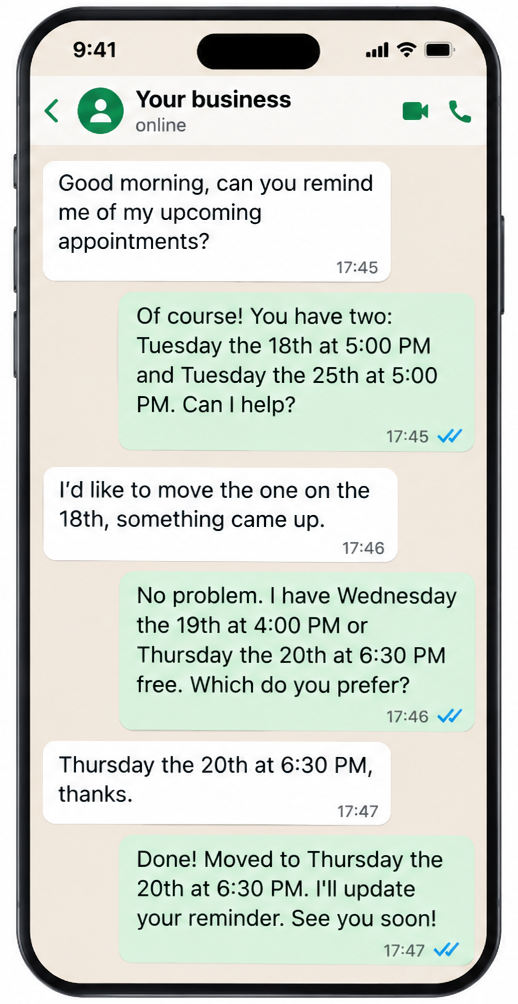
Anyone working by appointment knows the pattern. A WhatsApp message arrives while you are treating a client. Another one arrives five minutes later. By the end of the day there are dozens of conversations waiting for a reply, and most of them are the same four questions.
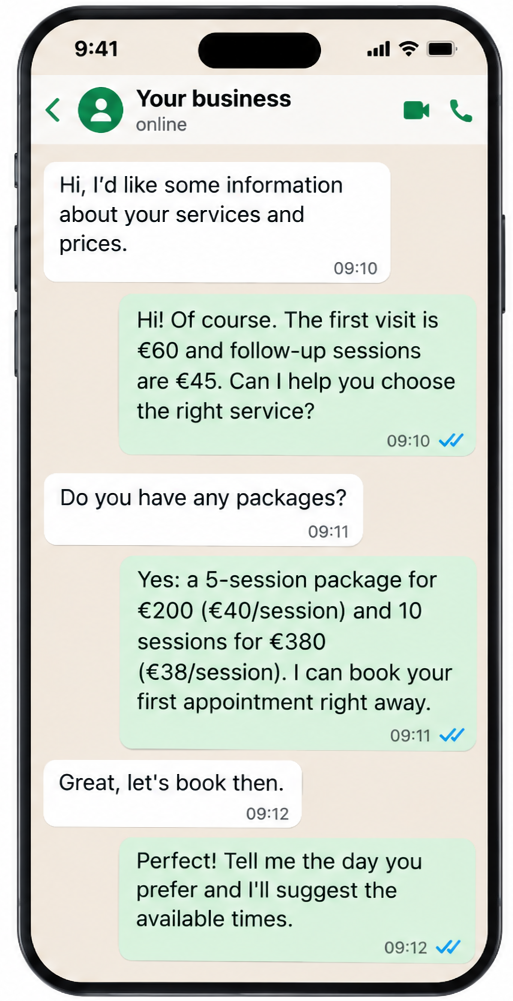
“How much does a session cost?”
“Do you have availability tomorrow?”
“Can I move my appointment?”
“Do you offer this treatment?”
Every conversation costs time. Every delayed reply increases the chance that the person books somewhere else. Physiotherapists, osteopaths, massage therapists, speech therapists and nutritionists all run into the same bottleneck, and it has very little to do with the calendar itself. The calendar is the easy part. The communication around it is what consumes the day.
Why practice management software does not close the gap
There are excellent practice management systems out there. Many of them handle appointments, invoicing, client records and administration extremely well, and Wably is not designed to replace them.
It complements them. If your current system already syncs appointments with Google Calendar, Wably becomes the intelligent communication layer sitting on top of it. You keep the software you know and add AI powered appointment management through WhatsApp.
At the same time, not every professional wants a management platform in the first place. Many independent practitioners deliberately keep things simple: the phone calendar is all they need, the entire business runs on WhatsApp Business and Google Calendar, and sitting in front of a computer to confirm appointments is exactly what they are trying to avoid. For them, simplicity is a competitive advantage, not a limitation.
Wably is built around that philosophy. The smartphone stays the primary workspace while the AI handles repetitive conversations in the background.
The hard part was never the language model
The last two years have brought extraordinary progress in Large Language Models. They understand natural language remarkably well. But understanding language is only half the problem.
LLMs are probabilistic systems. That flexibility is exactly what makes a conversation feel natural, and it becomes a liability the moment the assistant has to touch a real business workflow. Booking an appointment, checking availability, moving a slot, applying business rules: these operations demand deterministic behaviour. An assistant cannot invent a free slot. It cannot guess a price. It cannot behave differently under identical conditions.
So the engineering challenge was never “build a chatbot”. It was building an architecture that makes AI predictable and controllable.
The language model interprets intent. The application validates every action, enforces the rules, checks real availability and performs the operation.
The AI understands. The platform decides.
That separation is what turns a conversational model into something you can actually put in production in front of paying customers.
It is also the same principle that has shaped much of my work on AI infrastructure and private AI: let the model do what models are good at, and keep critical business decisions inside deterministic application logic.
Coexistence is what makes this possible
The single biggest unlock was WhatsApp Coexistence.
Historically, adopting the official WhatsApp Business API meant changing how you work. Many solutions required abandoning the WhatsApp Business mobile app, or managing every conversation from a desktop interface. For a solo practitioner, that trade is simply not worth it.
Coexistence removes the trade entirely. You keep the same phone number. You keep using the same WhatsApp Business app on your phone, exactly as you do today. Wably operates alongside it through the official API.
No new software to learn. No computer to keep running. No change in daily habits. From the outside nothing changes, while underneath the AI is managing conversations, bookings, reminders and follow ups.
Coexistence was therefore not just a convenience feature. It was an architectural requirement. If adopting automation means forcing a professional to abandon the mobile workflow they already use every day, the technology is solving the wrong problem.
Bookings are only the first step
Client communication continues before and after every appointment, so Wably automates the parts that directly affect the business.
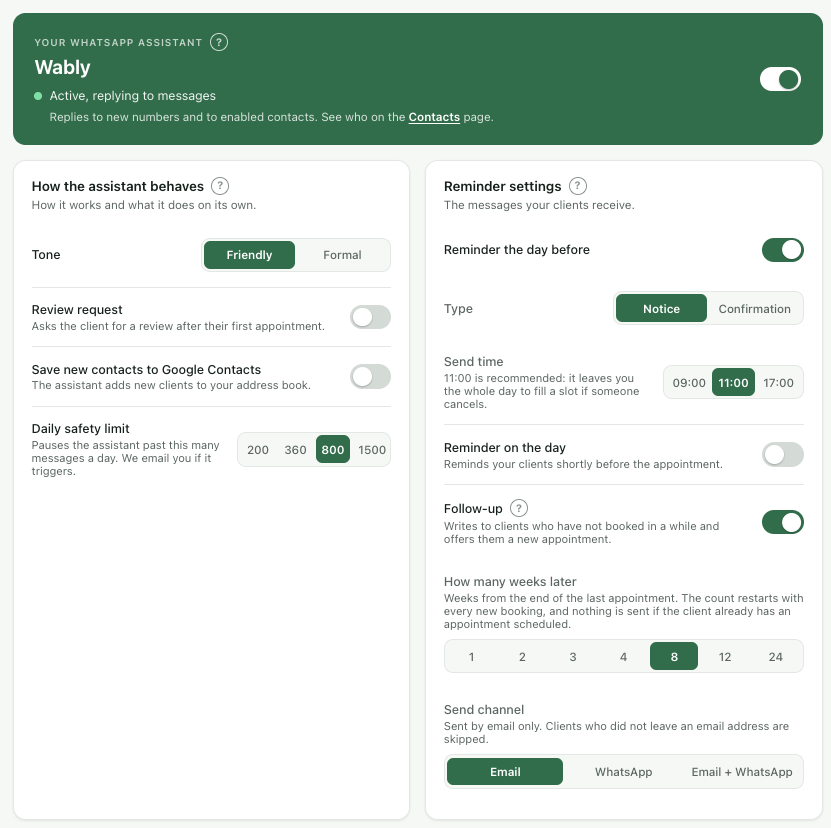
Appointment reminders go out automatically before the visit and help reduce no shows, keeping the professional’s calendar more predictable.
Automatic review requests are sent after a completed appointment, quietly building online reputation without the professional ever having to ask. Most practitioners know they should ask for reviews. Almost none of them do it consistently.
Contact management keeps the address book in sync, so every new client can end up in Google Contacts without manual entry.
All of it happens inside WhatsApp, the channel clients already use every day.
Built like enterprise software, priced for one person
Wably targets independent professionals and small practices, but the architecture follows the same principles I apply to enterprise systems: cloud native design, independent services, horizontal scalability, workflow automation, direct Google Calendar integration, official WhatsApp Business API integration, and a strict separation between AI and business logic.
On the data side the position is simple: your data stays under your control. The platform uses enterprise grade AI services with data processing in Europe. Client conversations are never used to train public models and are not added to third party training datasets.
For a professional handling client contact details and appointment data, that guarantee matters more than any feature list.
The same engineering mindset behind my work on cloud infrastructure and distributed systems shaped Wably: build for reliability first, keep responsibilities separated, automate what can be automated, and avoid making the user manage the infrastructure underneath.
Every architectural decision was made with one objective: a platform that is reliable today and ready to absorb whatever the AI ecosystem produces next
The goal is not automation
Automation is usually sold as a way to save time. I think that undersells it.
Instant replies can convert more enquiries into bookings. Reminders can reduce missed visits. Automatic review requests can improve local visibility. Availability outside business hours can capture clients you would otherwise miss at 9pm on a Sunday.
The outcome is not simply a shorter admin list. It is a better organised practice, a better client experience, a stronger online reputation and the potential for more revenue from the same working hours.
Artificial Intelligence should not make software more complicated. It should make people’s work easier.
That is the whole idea behind Wably.
Frequently asked questions
Do I have to change my WhatsApp number? No. Thanks to WhatsApp Coexistence you keep the same number and the same WhatsApp Business app on your phone.
Does it work with my current practice management software? If your software syncs appointments with Google Calendar, yes. Wably reads and writes the same calendar.
Which professions is it designed for? Anyone working by appointment: physiotherapists, osteopaths, massage therapists, speech therapists, personal trainers, tattoo studios, pet grooming, nutritionists … are the typical use case.
Are my client conversations used to train AI models? No. Conversations are processed on private LLM deployments hosted in Europe and are never used to train public models.
Can I try it before committing? Yes. There is a 30 day trial and you can cancel at any time.
Try it
If you work by appointment and WhatsApp is where your clients already talk to you, this is worth twenty minutes of your time.
👉 See how AI appointment booking and reminders on WhatsApp works and start your 30 day trial. Setup takes minutes, you keep your number, and you can cancel whenever you want.
This is only the beginning.